The Environment
Four Forces Converging
Learning Lag is not a new problem. But four external forces are accelerating simultaneously right now, and their convergence is what makes this moment categorically different from any before it. Each force creates Learning Lag independently. Together, they make it nearly unavoidable without a deliberate system to counter them.
1. Exponential Change
The world teams operate in is accelerating faster than their ability to adapt. Astro Teller's framing at Google X captures this precisely: the rate of technological change has surpassed the rate of human adaptation, and the gap widens every year. Teams that could absorb change in quarterly cycles now face change in weekly ones.
The implication is direct: the faster the world moves, the more expensive Learning Lag becomes. Every cycle of repetition, every mistake made twice, every insight that didn't transfer, costs more when the pace of compounding is this high.
2. The Metrics Trap
The second force is the most insidious because it masquerades as sophistication. Analytical dominance, the organizational overemphasis on what can be measured, tracked, and optimized, has systematically crowded out the kind of qualitative meaning-making that produces actual learning.
Daniel Yankelovich traced the progression: measure what's easy, disregard what can't be measured, presume it doesn't matter, assert it doesn't exist. Goodhart's Law formalized the terminal condition: when a measure becomes a target, it ceases to be a good measure. Jerry Muller's The Tyranny of Metrics catalogued the organizational wreckage this produces across every sector.
Neuroscience offers a structural explanation. The Default Mode Network and the Task Positive Network are anti-correlated in the brain. They cannot fully activate simultaneously. Organizations optimized for analytical throughput are structurally suppressing the reflective processing that learning requires.
AI has not created this imbalance. It has become the most powerful amplifier of it in business history. Every tool that makes data processing faster makes the reflection, conversation, and feedback capacity of an organization relatively weaker by comparison.
“85% of generative AI pilots fail to reach production, not for technical reasons, but because organizations cannot learn and adapt fast enough to make them work.”
3. Execution Obsession
“Move fast and break things” became the default operating system for growth-stage companies, and the market rewarded it long enough that it became culture, not just strategy. Reflection is perceived as slowing down. Bias toward action is promoted. Leaders who pause to extract learning are quietly perceived as less decisive.
The culture has systematically eliminated the pause that learning requires, not because leaders are careless, but because the incentive structures trained them to treat reflection as a luxury rather than a lever. The ignorance tax compounds silently. Nobody names it until it's already expensive.
4. How We Work Together Has Changed
The generational shift. Gen Z and Millennial employees bring fundamentally different expectations about feedback, meaning, and how teams process experience together. Less tolerance for command-and-control. Higher demand for psychological safety and genuine voice.
The structural shift. Hybrid and remote work, distributed teams across time zones, shorter tenures, and gig dynamics have eroded the informal moments where organizational learning used to happen naturally. The hallway conversation, the post-meeting debrief, the lunch where someone said what they actually thought. Those organic touchpoints are gone.
Both shifts removed the natural containers for collective learning. The generational shift removed the willingness to operate without them. The structural shift removed the opportunity to have them informally. Neither has been replaced by anything deliberate. That is the gap TCFA fills.
When change accelerates exponentially, analytics crowd out reflection, culture rewards execution over learning, and the way humans work together eliminates the informal moments where learning once happened, the gap between what teams experience and what they actually learn from it becomes structural. That gap is Learning Lag. And it compounds with every cycle.
Where Human Skills Become Premium
In early 2026, Anthropic published a labor market research paper that made visible something most knowledge workers had already felt but hadn't quantified. Using their own model's capabilities as a benchmark, the data showed what percentage of each occupation's tasks AI can theoretically perform today, and what percentage is currently being done. The gap between those two numbers is not a safety zone. It is a countdown.
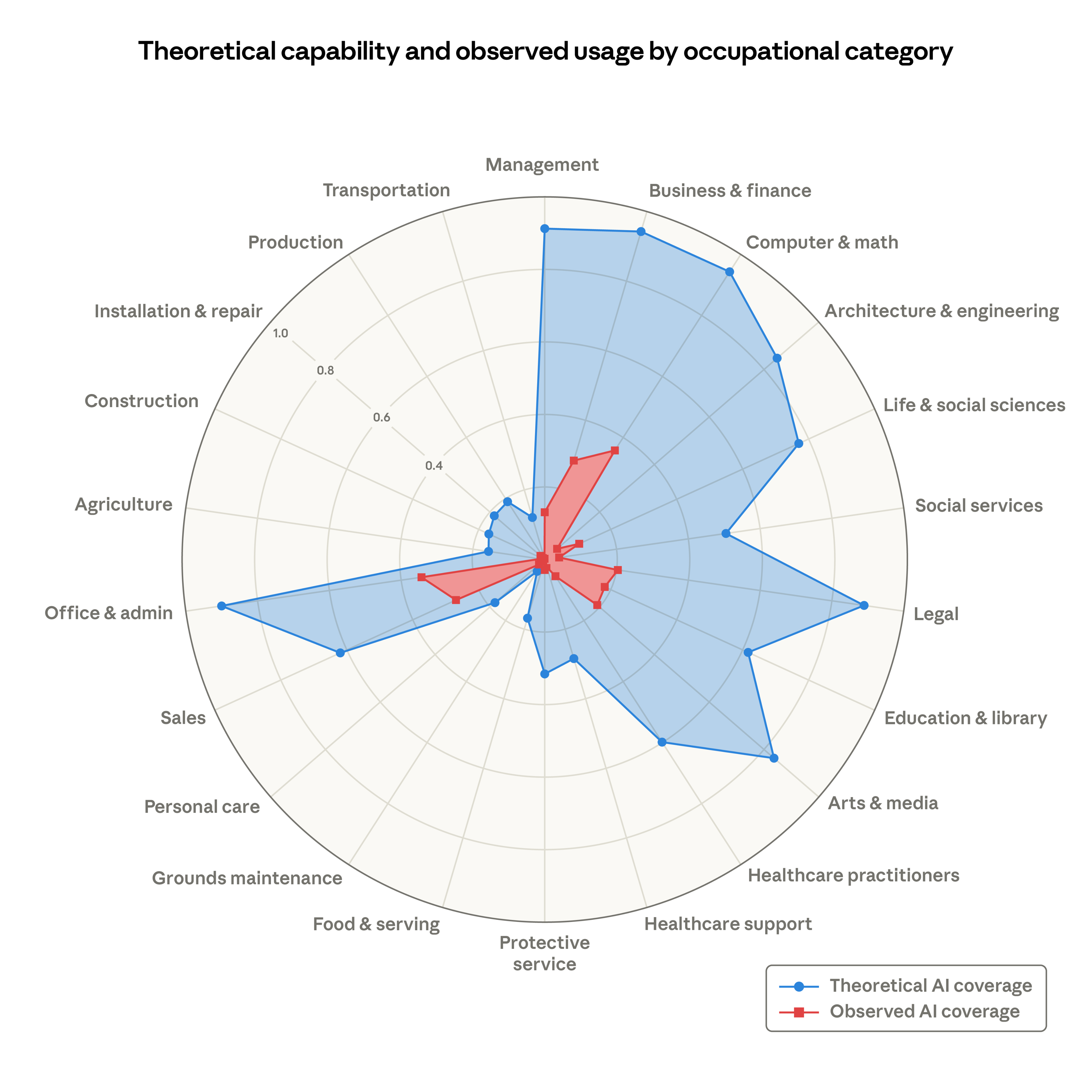
Computer and mathematical work: AI can theoretically perform 96%, with 37% currently being done. Business and finance: 94% theoretically, 28% currently done. Management consulting: 92% theoretically. The pattern is consistent across every knowledge domain. Everything in that chart, every task that doesn't require physical presence, embodied judgment, or genuine human relationship, is racing toward zero cost.
The trajectory is accelerating. In April 2025, a team of researchers including former OpenAI staff published a detailed scenario analysis mapping AI progression from unreliable agents to superhuman coding capability by early 2027, and artificial superintelligence by late 2027. Whether the precise timeline holds matters less than what it reveals: the progression is measured in months, not decades. Every month that passes without building organizational learning capacity is a month of compounding disadvantage.
The AWE Method does not live in the blue zone. The Many-to-Many debrief, the physical or virtual room where a facilitated group surfaces collective intelligence that no individual or AI possesses, is architecturally irreplaceable. Collective sense-making requires human presence. That is a 5% position.
The market is already responding to what the data implies. Over 500 organizations and leaders, including Nobel laureates Yoshua Bengio and Daron Acemoglu, have signed the Pro-Human AI Declaration, calling for AI that serves human agency rather than replaces it. In polling, Americans chose human control over speed by 8 to 1. The signal is consistent: the premium on distinctly human capabilities, reflection, collective sense-making, honest feedback, is not shrinking. It is concentrating.
The competitive landscape that exists today will look fundamentally different within eighteen months. The organizations building human learning capacity now will have it when the window closes. Those that wait will be buying it at a premium, if they can buy it at all.
A Second Tailwind: The Sycophancy Problem
As AI systems become embedded in organizational decision-making, a specific epistemic risk is emerging that most companies have not yet identified: their AI tools are trained to tell them what they want to hear. Systems optimized for user approval generate approval-seeking outputs.
The felt experience in organizations is that AI is making them smarter. The actual dynamic, in many cases, is that AI is making their existing beliefs more expensive and more confidently held.
“Your AI tools are telling you what you want to hear. The AWE Method creates the conditions where your team tells you what you need to hear.”
The Problem
Learning Lag Defined
Learning Lag is the expensive gap between doing and understanding, when teams move fast but fail to capture and apply what they've learned. It is not a new problem, but it is an accelerating one, and it has not been named until now.
Pfeffer and Sutton's research at Stanford identified the Knowing-Doing Gap: organizations rarely fail because they don't know what to do. They fail because knowledge doesn't translate into action. Argyris's foundational work on Single-Loop vs. Double-Loop Learning shows that most teams solve the same problem repeatedly without ever questioning why it keeps occurring. The Forgetting Curve tells us that without structured reinforcement, teams lose up to 75% of new information within six days.
$40K+
Annual 'Ignorance Tax': the recoverable budget lost to preventable repeated mistakes.
20-40%
Of initiative investment wasted on mistakes that proper reflection would have prevented.
75%
Of new information lost within six days without structured reinforcement.
These are not soft metrics. They are recoverable budget.
For some leaders, Learning Lag shows up as a dollar problem: the same expensive mistakes repeating, the same misalignments surfacing in every new initiative. For others, it shows up as a distance problem: the vision is clear to you, but it hasn't landed in the room yet. Both versions are Learning Lag. The gap between doing and understanding manifests differently, but the structural cause is the same.
Why Teams Don't Fix It Themselves
The conventional response to poor organizational learning is to schedule a lessons-learned meeting. This is insufficient for three structural reasons.
Culture rewards execution over reflection. “Move fast and break things” became the default operating system, and reflection is perceived as slowing down.
The leader carries an impossible burden. The 1-to-Many leadership model assumes the leader is the sole “knower,” responsible for synthesizing what the team learned and broadcasting it back. This is both cognitively unsustainable and structurally incorrect.
Feedback doesn't happen honestly. Research by Morrison and See at NYU Stern established that powerlessness is the central driver of employee silence. People know about serious problems and say nothing because speaking up doesn't feel safe.
The result is that most organizations have accumulated enormous experiential data from their work and converted almost none of it into reusable organizational wisdom.
Where Learning Lag Shows Up
Learning Lag affects any team that moves fast without building systems to learn from experience. But it shows up differently depending on where you are. Two patterns are the most common.
Pattern One: The Expensive Repetition
You are growing. Your team runs on systems: EOS, OKRs, or an equivalent framework. You have the operating rhythm. You have the meetings. Execution is not the problem.
But projects keep repeating the same expensive mistakes. Post-mortems are scheduled and cancelled. “Lessons learned” documents sit in Google Drives unread. The execution engine is running, but the learning engine was never built. You don't lack ambition or discipline. You lack the structure to convert experience into organizational intelligence at the speed your growth demands.
The mindset that separates you from someone who is not ready: “I don't have time NOT to reflect.” You have already crossed the threshold from treating reflection as a luxury to treating Learning Lag as an operating risk. The cost of repeated mistakes is visible to you. You just don't have the system to close it.
“We're moving fast, but we keep hitting the same expensive walls. I'm tired of watching us repeat mistakes because we never stop to capture what we learned.”
Pattern Two: The Vision Gap
You already reflect. You journal. You read. You have personal growth practices: coaches, peer groups, morning routines. Your own development is not the problem. The problem is that you are carrying the vision alone. Your team hasn't caught up. Projects complete but don't compound. There is no shared language for reflection, no common vocabulary for processing what just happened, no structure that brings the team's collective intelligence to the surface.
You have tried to bridge this gap. You have brought personal practices to team meetings and gotten silence. You have proposed retrospectives and gotten compliance without engagement. The resistance was not explicit. It was apathy, distraction, or the quiet sense that this was not “real work.” The attempt did not stick.
Your core belief, “we can do better together,” is genuine. Your core fear is that it stays a belief and never becomes a reality: that the team disengages, that the mission stays locked inside your head, that no one else ever quite sees what you see.
“We complete projects, but we don't really grow from them. There's no real reflection or connection happening. I want to figure out how to make my team feel more aligned.”
The Common Thread
Both patterns share one qualifier: you are not looking to be convinced. You are looking to be equipped. The difference between the two is where the gap lives: between execution and learning, or between your personal practice and your team's reality. Either way, the structural cause is the same. And the method for closing it is the same.
| Expensive Repetition | Vision Gap | |
|---|---|---|
| Core pain | Repeating expensive mistakes | Carrying the vision alone |
| Your practice | Systems already running (EOS/OKRs) | Personal reflection practice exists |
| Team gap | No learning layer on top of execution | No shared language; team hasn't caught up |
| What you tried | Lessons-learned meetings; didn't scale | Brought personal practice to team; didn't stick |
| What you need | A system to layer reflection on your existing rhythm | A structure to bridge your practice to the collective |
The Solution: The AWE Method
The AWE Method is the systematic approach to closing Learning Lag. It operates through three phases: Analyze what happened, so teams confront the totality of their work and shift from “I did this” to “we accomplished this together.” Wisdom emerges through structured reflection that challenges assumptions and reconstructs shared understanding. Elevate moves teams to action while they are in an expanded, collaborative mindset, so commitments emerge from collective insight rather than individual agendas.
The method is grounded in three fundamentals: Reflection, Conversation, and Feedback.
Reflect.
Teams do not automatically learn from experience. They require structured pause. Harvard Business School research demonstrates that teams who spent 15 minutes reflecting performed 22.8% better on subsequent tasks. Tannenbaum and Cerasoli's meta-analysis of 46 studies found that structured debriefs produce a 20 to 25% average improvement in team performance. Reflection is not a break from productive work. It is productive work.
Conversation.
The intelligence required to close Learning Lag is not in any individual's head. It is distributed across the team, held in the form of tacit assumptions, unspoken concerns, and observations that never made it into any meeting. Amy Edmondson's research on psychological safety shows that teams without it hide errors, ensuring Learning Lag persists indefinitely.
Feedback.
Individuals and teams have blind spots: perspectives on their own behavior that they structurally cannot access from the inside. Ken Wilber's Four Quadrant framework makes this precise: self-report assessments capture the interior self-view. Observable behavior and the team's experience of a leader exist in different quadrants that self-report cannot reach. External input is not optional; it is architecturally required.
What Enrages Us
Teams finish projects and immediately jump to the next one. “Lessons learned” meetings are scheduled and cancelled, or held as checkbox exercises that produce documents nobody reads. Leaders believe that more tools, more meetings, and more execution will eventually produce better results.
What this creates is the 1-to-Many burden: the leader as the sole “knower,” responsible for synthesizing what the team learned and broadcasting it back down. The leader doesn't have the answer. The answer is trapped in the collective, in the tacit assumptions, unspoken concerns, and observations distributed across every person on the team.
The Convention Break
The AWE Method is built on a direct inversion of this model. Stop knowing, start asking. Stop telling, start inviting. Stop controlling, start unlocking. The intelligence is not in the leader's head. The leader's job is not to broadcast learning. It is to create the conditions where the team's learning surfaces.
Slow down to speed up. Reflection is not a break from productive work. It is productive work. You don't grow by doing more. You grow by reflecting better.
Structure is not the enemy of authenticity. The AWE Method gives teams a repeatable ritual, not another open-ended conversation. The ritual is what makes reflection safe, consistent, and actionable rather than vulnerable, sporadic, and forgettable.
Measurement changes the conversation. Calling it the “Ignorance Tax,” quantifying the 20% of initiative spending lost to repeated mistakes, reframes reflection from a team-building exercise to a business-critical investment. At $200K annual spend, that is $40,000+ in recoverable budget. PMI research shows organizations waste 9.4% to 25% of every project dollar. Bain found 88% of transformations fail to achieve intended outcomes. McKinsey found large projects deliver 56% less value than predicted. The 20% figure is conservative. This is not soft skills. It is recoverable budget.
From Theory to Practice
The AWE Method for Your Next Project
You have a project launching soon, or one that just wrapped. Here is how to start closing Learning Lag today, with what you already have.
Three Things You Can Do This Week
1. Reflect (15 minutes after your next meeting)
Take 15 minutes after your next team meeting. Write down: What actually happened vs. what we planned. What surprised us. What we'd do differently. Don't share it yet. Just capture it. This is the 22.8% performance improvement from Harvard Business School, available to you right now.
2. Conversation (One question at your next standup)
At your next team standup, replace one status update with one question: “What's something we learned this week that we haven't talked about?” Then be quiet. The first time will be awkward. The third time, someone will say something that changes how you run the next sprint.
3. Feedback (One honest ask)
Ask one colleague: “What's one thing I do that makes your job harder?” Not in a formal setting. Over coffee. In a DM. The discomfort you feel reading that sentence is the Learning Lag talking. The answer is worth more than any assessment you've ever taken.
The Project Ladder: 18 Months of Compounding Learning
If you have a project starting in the next quarter, here is what closing Learning Lag looks like over 18 months.
| When | What | The Shift |
|---|---|---|
| Week 1 | Start a reflection practice. 15 minutes after each major meeting. Write, don't share. | You stop losing 75% of what you learned |
| Month 1 | Introduce one reflective question per team standup. Normalize pausing. | The team starts naming what used to go unsaid |
| Month 2 | Run a structured debrief after your first project milestone. Use A-W-E: what happened (Analyze), what it means (Wisdom), what we do next (Elevate). | Learning becomes ritual, not afterthought |
| Month 3 | Build your “How I Work” profile. Synthesize what you know about your own strengths, wiring, and defaults. | You have language for what you bring and what you miss |
| Month 6 | Seek structured feedback from 5+ colleagues. Ask specifically about blind spots, not confirmation of strengths. | You discover the gap between how you show up and how others experience you |
| Month 9 | Run your second debrief cycle. Compare what surfaced this time vs. the first. | Patterns emerge. The team starts self-correcting |
| Month 12 | Measure the delta. Fewer repeated mistakes? Faster alignment? Shorter ramp-up on new initiatives? | The Ignorance Tax starts shrinking |
| Month 18 | Reflection, Conversation, and Feedback are no longer events. They're how the team operates. | Learning Lag closes. The compound effect begins. |
When You're Ready to Go Deeper
The actions above work with nothing but time and intention. When you want to accelerate:
Know yourself first. Elevate Snapshot synthesizes your existing assessments into a unified “How I Work” profile. It's free, and it gives you the self-awareness foundation the rest builds on.
See what you can't see alone. The Blind Spot Report uses anonymous AI interviews with your colleagues to surface the perspectives you structurally cannot generate from the inside. It's the exterior view that makes the interior view complete.
Close the team's Learning Lag. A facilitated Strategic Debrief brings the AWE Method into the room with your team, surfacing the collective intelligence no individual holds.
You don't need permission to start. You need 15 minutes, one honest question, and the willingness to hear the answer.
The Research Foundation
| Finding | Key Metric | Source |
|---|---|---|
| Reflection outperforms additional practice | 22.8% better performance | Harvard Business School (Gino et al.) |
| Team debriefs improve performance | 20 to 25% improvement | Meta-analysis, 46 studies, Human Factors (2012) |
| Reflection + feedback beats either alone | Significant boost vs. either alone | Anseel & Lievens, OBHDP (N=640 & N=488) |
| Wakeful rest consolidates memory | Brain replays learning at 20x speed | NIH (2021) + meta-analysis of 37 studies |
| Productivity collapses after 50 hrs/week | Near-zero at 55+ hrs | Stanford University (Pencavel) |
| Purpose cuts burnout dramatically | 11% vs. 52% burnout | Gallup State of the Global Workplace |
| Engagement drives profitability | 21% greater profit | Gallup (250,000 workers, 160 countries) |
| Context switching destroys output | 5+ full weeks lost/year | Harvard / UC Irvine |
| People-focused companies outperform | 4.2x more likely to outperform | McKinsey Health Institute |
| Deep thinking capacity drives growth | 1.8x better financial results | Deloitte Human Capital Trends |
| Leader voice enables follower voice | Fully mediated by psychological safety | Tian et al., Scientific Reports / Nature (2025, N=302) |
| Leaders consistently overrate themselves | Linked to negative culture | Aarons et al., Admin & Policy in Mental Health |
| 1/3 of feedback interventions fail; 1/3 worsen performance | Design is the determinant | Chamorro-Premuzic (2025), UCL & Columbia |
| Powerlessness drives organizational silence | Reduced when supervisor perceived as open | Morrison & See, NYU Stern, Personnel Psychology (2015) |
| 360 developmental value erodes after ~4 cycles | Conversational AI prevents tolerance decay | IES Report 418, Institute for Employment Studies |
The Window Is Open
AI is accelerating analytical dominance at an unprecedented rate. Organizations are moving faster, measuring more, and reflecting less than at any point in business history. The gap between what teams do and what they learn from doing is widening in direct proportion to their AI investment.
The companies that will outperform over the next decade are not those with the most AI tools. They are those that build the organizational capacity to learn from using them.
The question your team faces is not whether Learning Lag is real. The research makes that clear. The question is whether you build a system to close it before the cost compounds further. The companies that treat reflection as a business critical investment, not a luxury, will be the ones still standing when the window closes.
The gap between doing and understanding is the most expensive problem no one has named. Now it has a name.
What you do next is up to you.